Finals Are Here: How to Finish Your Semester Strong (Even If You’re Behind) – 2026 Guide

I. Introduction
• The “Finals Panic” Reality
There’s a very specific kind of panic that hits at this point in the semester. It’s not the early-term stress where everything still feels manageable, and it’s not the calm confidence of someone who has stayed consistently on top of their work. This is different. This is the moment you open your learning portal, scroll through your courses, and feel your chest tighten as you realize just how much is left undone.
For students in 2026, this pressure feels even more intense. Academic life has become more demanding, not less. Syllabi are packed, deadlines overlap, and many courses now blend continuous assessments with high-stakes finals. On top of that, digital distractions are constant. Every study session competes with notifications, social media, streaming platforms, and the simple mental fatigue that comes from being online all the time.
The result? Falling behind has become incredibly common. Even students who start strong often find themselves slipping somewhere along the way. One missed assignment turns into two. One confusing topic gets skipped and then snowballs into an entire unit that doesn’t make sense. Before long, catching up starts to feel impossible.
This is where the panic sets in.
You might recognize some of these thoughts:
- “There’s too much to do—I don’t even know where to start.”
- “I’ve already wasted so much time.”
- “Even if I try now, will it even make a difference?”
That mental spiral is dangerous, not because it reflects reality, but because it leads to inaction. When everything feels urgent, it’s easy to do nothing. When everything feels important, it’s hard to choose what to focus on. And when the pressure builds high enough, many students default to avoidance—scrolling, procrastinating, or convincing themselves they’ll “start tomorrow.”
But here’s the truth: the situation is rarely as hopeless as it feels.
Being behind is a problem—but it’s a solvable one. The difference between students who recover and those who don’t usually comes down to one thing: strategy. Not motivation, not intelligence, and not even time. Strategy.
If you approach the final weeks the same way you approached the rest of the semester, you’ll likely stay stuck. But if you shift your mindset—from trying to do everything perfectly to focusing on what actually moves your grades—you can still turn things around in a meaningful way.
• The GradeSmiths Promise
At GradeSmiths, we’ve seen this pattern play out countless times. Students hit the final stretch feeling overwhelmed, convinced they’ve fallen too far behind, only to realize—once they adopt the right approach—that there’s still a clear path forward.
So let’s be direct: it is not too late to course-correct.
You may not have enough time to master every concept in every subject. You may not be able to submit every assignment at the level you originally intended. But you do have enough time to make smart decisions, recover lost ground where it matters most, and push your grades higher than you think.
This guide is built around that idea.
Instead of offering generic advice like “study harder” or “stay motivated,” we’re going to walk through a practical triage plan—one designed specifically for students who are short on time and under pressure. The goal is simple: maximize your GPA with the time you have left.
You’ll learn how to:
- Identify which tasks actually matter most
- Focus your energy where it will have the biggest impact
- Use study methods that deliver results quickly
- Avoid the common mistakes that waste time in the final weeks
Think of this as your reset point. Not a fresh start, but a strategic pivot.
You don’t need perfection right now. You need clarity, focus, and execution.
II. Step 1: The “Academic Triage” (Prioritization)
• Inventory Your Deficits
Before you can fix anything, you need a clear picture of where you stand. And that means being brutally honest.
Start by listing everything—every missing assignment, every upcoming exam, every pending discussion post, every project that isn’t finished yet. Don’t rely on memory. Open each course, check each syllabus, and write it all down in one place.
At first, this might feel overwhelming. Seeing everything at once can make the workload look even bigger than it felt before. But this step is essential. You cannot prioritize what you haven’t fully identified.
Think of this as creating a map. Right now, you’re operating with a vague sense of being “behind,” which makes it hard to act. Once everything is listed clearly, the situation becomes more concrete—and therefore more manageable.
Clarity reduces anxiety. It turns a mental cloud of stress into a defined set of tasks.
• The Weighting Game
Once your list is complete, the next step is to figure out what actually matters.
Not all assignments are created equal. Some might be worth 2–5% of your final grade, while others—like major projects or final exams—could be worth 20%, 30%, or even more. If you treat everything as equally important, you’ll waste valuable time on low-impact tasks.
Instead, go through your list and assign a weight to each item based on its contribution to your final grade. Then rank them from highest to lowest impact.
This is where your focus should shift.
If you only have a limited number of hours (which you do), those hours need to be invested where they will produce the greatest return. A high-weight assignment done reasonably well will often improve your grade more than several low-weight tasks done perfectly.
This is the core principle of academic triage: prioritize impact over effort.
• The “Pass/Fail” Reality Check
Now comes the part that many students struggle with—accepting that you cannot do everything at the highest level.
At this stage of the semester, perfection is no longer the goal. Progress is.
For each course, ask yourself:
- Is this a class where I can realistically aim for an A?
- Or is this a class where I need to focus on passing or maintaining my current grade?
Be honest. Not pessimistic, but realistic.
In some subjects, it may still be worth pushing hard for top marks—especially if you’re already close. In others, the smarter move may be to ensure you meet the minimum requirements and avoid losing more points.
This is where the phrase “done is better than perfect” becomes critical.
A completed assignment submitted on time—even if it’s not your best work—is almost always better than an unfinished one that earns a zero. The goal is to keep accumulating points, even if they’re not perfect.
Making peace with this trade-off can feel uncomfortable, but it’s one of the most powerful mindset shifts you can make in the final weeks.
III. Step 2: High-Efficiency Study Methods
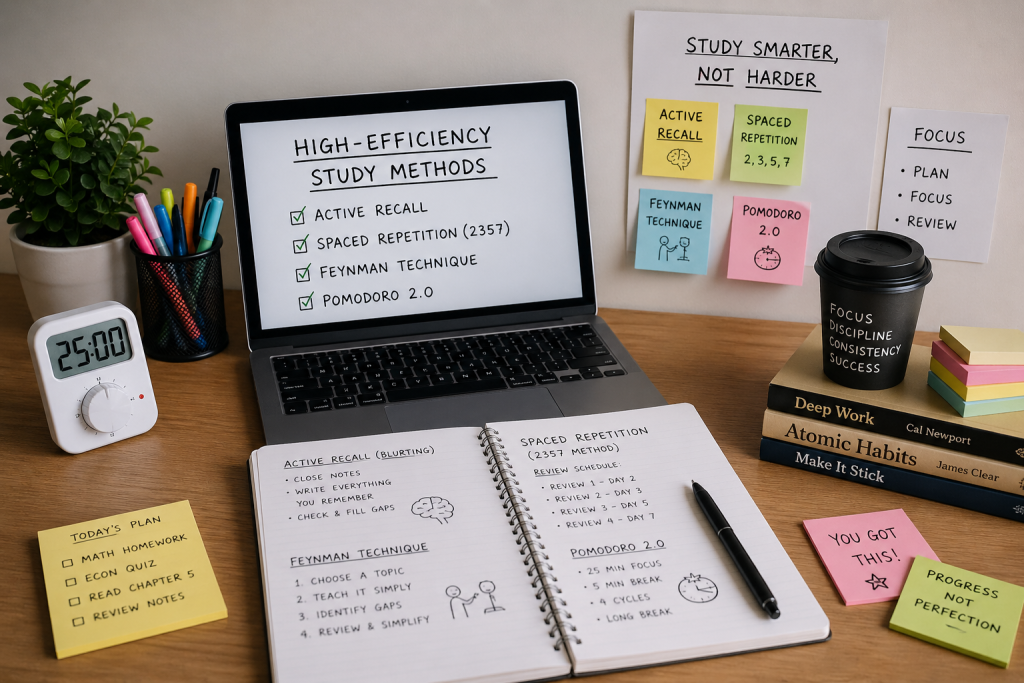
• Active Recall vs. Passive Reading
One of the biggest mistakes students make under pressure is defaulting to passive study methods. Re-reading notes, highlighting textbooks, or watching lectures again might feel productive, but they are often inefficient—especially when time is limited.
What you need instead is active recall.
Active recall forces your brain to retrieve information rather than simply recognize it. Techniques like “blurting” (writing down everything you remember about a topic without looking at your notes) or self-quizzing are far more effective for strengthening memory.
The difference is simple: passive reading makes information feel familiar, while active recall makes it usable.
In the final weeks, usability is what matters.
• The 2357 Spaced Repetition Method
Cramming might help in the short term, but it doesn’t hold up well over multiple exams or consecutive study days. A more effective approach is spaced repetition.
The 2357 method is a simple way to structure this:
- Review material after 2 days
- Then again after 3 days
- Then after 5 days
- And finally after 7 days
This pattern helps reinforce information just as you’re about to forget it, strengthening retention without requiring endless repetition.
Even if you don’t have a full week, applying a compressed version of this method can still improve how much you retain between now and your exams.
• The Feynman Technique
If you truly want to understand something quickly, try explaining it.
The Feynman Technique is based on a simple idea: if you can’t teach a concept clearly, you don’t fully understand it. Take a topic and explain it as if you’re teaching it to someone with no background knowledge.
Use simple language. Avoid jargon. Break it down step by step.
If you get stuck, that’s a signal—not a failure. It shows you exactly where your understanding is weak, so you can go back, review, and try again.
This method is especially powerful for complex subjects because it forces clarity.
• Pomodoro 2.0
Long, unfocused study sessions often lead to burnout. Instead of trying to power through for hours, use structured focus blocks.
The Pomodoro method—25 minutes of focused work followed by a short break—helps maintain concentration while preventing mental fatigue. After a few cycles, take a longer break to reset.
Think of this as managing your energy, not just your time.
Consistency beats intensity, especially when you’re under pressure.
IV. Step 3: Technology & Tools for 2026
• Organization
Staying organized is half the battle in the final weeks. Tools like Notion or My Study Life can help you track deadlines, manage tasks, and visualize your workload in one place.
When everything is clearly laid out, it becomes easier to plan your time and avoid last-minute surprises.
• Retention
For memory-heavy subjects, tools like Anki can be incredibly effective. These platforms use spaced repetition algorithms to show you flashcards at optimal intervals, helping you retain information more efficiently.
Instead of guessing what to review, the system guides you.
• Focus
Distractions are one of the biggest obstacles to productivity. Apps like Forest turn focus into a game—you grow a virtual tree by staying off your phone, and if you leave the app, the tree dies.
It’s simple, but surprisingly effective.
• Accountability
Studying alone can make it easier to drift off track. Virtual study rooms like StudyStream or Focusmate create a sense of accountability by pairing you with others who are also working.
Even without direct interaction, the shared environment can help you stay focused and committed to your study sessions.
V. Step 4: Maintenance & Mindset (The “Fuel” for the Finish)

• The 8-Hour Rule
When deadlines pile up, sleep is often the first thing students sacrifice. It feels logical—more time awake should mean more time to study. But in reality, cutting sleep is one of the fastest ways to reduce your performance.
Your brain doesn’t just store information while you’re studying. It processes and consolidates that information while you sleep. Without enough rest, even hours of studying can become less effective because your brain hasn’t had the chance to organize and retain what you learned.
Pulling an all-nighter might help you feel productive in the moment, but it usually leads to slower thinking, weaker memory recall, and increased stress the next day. You end up spending more time re-learning things you already covered, which is the opposite of efficient.
The 8-hour rule isn’t about perfection—it’s about prioritizing cognitive function. Even getting close to a full night’s sleep can dramatically improve your ability to focus, understand concepts, and perform during exams.
If you’re choosing between one more hour of exhausted studying and one more hour of sleep, sleep is often the better investment.
• Strategic Breaks
When you’re under pressure, it’s tempting to stay glued to your desk for as long as possible. But constant work without breaks leads to diminishing returns. Your focus drops, your motivation fades, and even simple tasks start to feel harder than they should.
That’s where strategic breaks come in.
Instead of scrolling on your phone or switching to another screen, take short, intentional breaks that actually reset your mind. One of the most effective options is what many students call a “touch grass” moment—spending 15–20 minutes outside, away from screens.
Fresh air, natural light, and physical movement help reset your mental state. It reduces stress, improves mood, and gives your brain a chance to recover before the next study session.
These breaks aren’t wasted time. They’re part of the process.
Think of them as maintenance for your focus. Without them, your productivity gradually declines. With them, you can sustain high-quality work for longer periods.
• Caffeine Management
Caffeine can be a useful tool during finals—but only if you use it strategically.
Many students rely heavily on coffee or energy drinks, especially when they’re feeling tired or overwhelmed. The problem isn’t caffeine itself—it’s how it’s used. Large amounts consumed at random times often lead to spikes in energy followed by crashes that make it even harder to concentrate.
Instead, think of caffeine as something to time, not just consume.
Use it at the start of a focused study session or before an exam, when you need a boost in alertness. Avoid consuming it too late in the day, as it can interfere with your sleep—and poor sleep will cost you far more than caffeine can make up for.
Also, be mindful of how much you’re taking in. More isn’t always better. A moderate amount can improve focus, but too much can increase anxiety, jitteriness, and fatigue once the effects wear off.
Used properly, caffeine can support your performance. Used poorly, it can work against you.
VI. Conclusion
• The Final Push
At this point in the semester, it’s easy to focus on everything that hasn’t gone according to plan. The missed deadlines, the topics you didn’t fully understand, the time you wish you had used differently.
But none of that changes what you can do next.
What matters now is action—small, immediate, and consistent action. You don’t need to fix everything today. You don’t need to have a perfect plan before you start. You just need to take the first step.
That step could be as simple as organizing your assignments into a list. It could be prioritizing your top three tasks. It could be setting a 25-minute timer and starting one piece of work you’ve been avoiding.
Momentum builds from movement, not from overthinking.
Once you start, the situation becomes clearer. Tasks feel more manageable. Progress—no matter how small—creates a sense of control that replaces panic.
The final weeks of the semester aren’t about perfection. They’re about finishing strong with the time and energy you have left.
• Call to Action
If you found this guide helpful, don’t stop here.
GradeSmiths is built to support students exactly in moments like this—when the pressure is high and the margin for error is small. From practical study strategies to assignment support and time-saving academic resources, everything is designed to help you perform at your best when it matters most.
Subscribe to GradeSmiths for more study hacks, productivity strategies, and up-to-date academic insights tailored for students navigating the challenges of 2026.
Because finishing strong isn’t about luck—it’s about having the right tools, the right mindset, and the right support.
FAQ: Finishing the Semester Strong
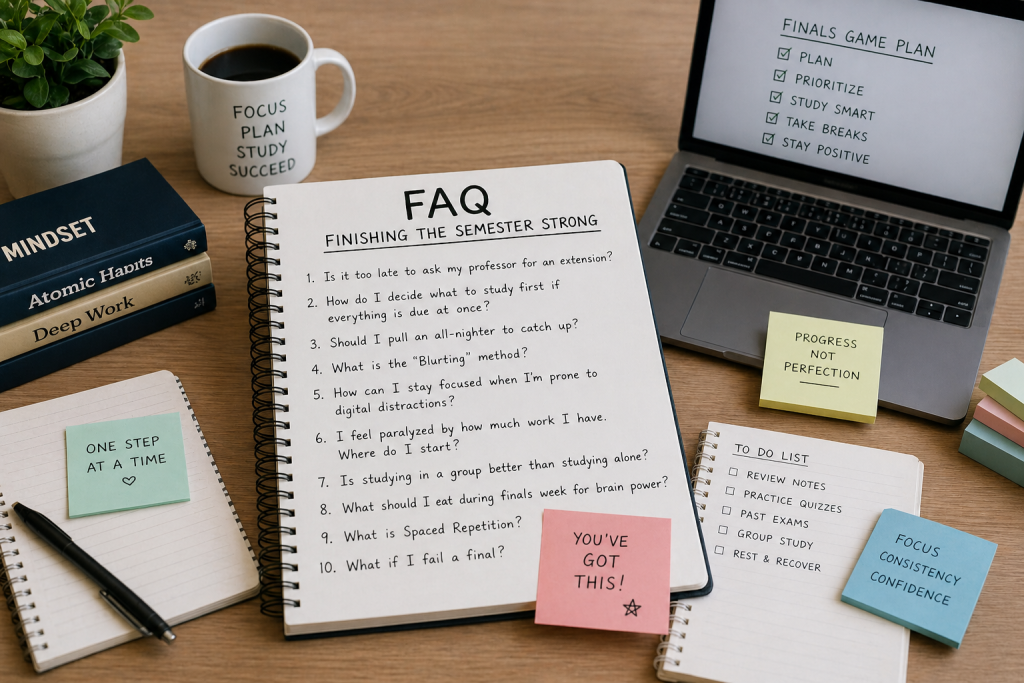
- Is it too late to ask my professor for an extension?
The earlier you ask, the better. Be honest about your situation and propose a specific, realistic deadline for the makeup work. Clear communication increases your chances of getting a positive response.
- How do I decide what to study first if everything is due at once?
Focus on the highest-impact tasks first—assignments or exams that carry the most weight and have the closest deadlines. This ensures your effort produces the greatest results.
- Should I pull an all-nighter to catch up?
No. Sleep is essential for memory and focus. A well-rested brain will perform better than one that has been pushed past its limits.
- What is the “Blurting” method?
It involves writing down everything you remember about a topic without looking at your notes, then checking for gaps. It’s a powerful form of active recall.
- How can I stay focused when I’m prone to digital distractions?
Use tools like focus apps or enable “Do Not Disturb” mode. You can also place your phone in another room to remove temptation entirely.
- I feel paralyzed by how much work I have. Where do I start?
Start small. Pick one class and spend 20 minutes on a single task. Breaking the cycle of inaction is more important than choosing the perfect starting point.
- Is studying in a group better than studying alone?
It depends. Groups are great for explaining concepts and staying accountable, but only if they remain focused and structured.
- What should I eat during finals week for brain power?
Choose balanced meals with complex carbohydrates, protein, and fruits or vegetables. Avoid high-sugar snacks that cause energy crashes.
- What is Spaced Repetition?
It’s a study method where you review material at increasing intervals over time, helping move information into long-term memory.
- What if I fail a final?
One exam does not define your abilities or your future. Most institutions offer support systems to help you recover and plan your next steps. Focus on learning from the experience and moving forward.