4 Quick Tips to Answer Rational Reasoning Online Homework and Improve Scores
- Core Ideas at a Glance
- What is Rational Reasoning and Its Role in Math Reasoning
- How to Approach Rational Reasoning Online Homework Effectively
- 4 Quick Tips for Solving Rational Functions Test Questions
- Practice Problems to Improve Rational Functions Test Scores
- Improving Math Reasoning Skills for Better Homework Scores
- Conclusion – Boost Your Scores with Effective Rational Reasoning Tips
- Frequently Asked Questions About Rational Reasoning Online Homework and Rational Functions Tests
Ever wondered why some students breeze through complex math modules while you feel stuck staring at a blank screen? Modern education no longer focuses only on memorising facts, yet many students still rely on this method. Logical reasoning builds skills like critical thinking and problem-solving.
A Nature Scientific Reports Article indicates that STEM students find an online homework system for mathematics more stressful than traditional exams. This stress often comes from the platform’s rigid nature. However, success in your Pathways to Calculus Rational Reasoning homework isn’t about working harder, but recognising the “hidden architecture” of the problems.
The article further suggests the active-learning approaches that include AI tutoring to develop rational reasoning have shown improved results for STEM students. This detailed guide provides important tips for finding rational reasoning online homework answers and building critical thinking skills. Whether you are dealing with Rational Reasoning IMathAS or a complex critical reasoning test, it will help you navigate the process.
Core Ideas at a Glance
- In systems like IMathAS, the format of your input matters as much as the value itself.
- When practising for your logical reasoning assignments, always write down every step of the way, so you can remind yourself whenever there’s confusion.
- Once you arrive at a solution, re-read the prompt. Online systems often swap units or ask for the “inverse” at the last second to test your attention to detail.
- Strengthening your general math reasoning is the most effective way to improve your performance on rational reasoning assignments.
- There are many useful online homework aids, like Desmos Graphing Calculator and Khan Academy, that help you calibrate your logic and improve your grades in logical reasoning exams.
What is Rational Reasoning and Its Role in Math Reasoning
Rational reasoning is the backbone of higher-level mathematics that you must develop a good grip on to succeed. In the context of Rational Reasoning Precalculus homework, it refers to your ability to understand how different quantities relate to one another. You don’t just learn to move numbers around, but also the logic behind every change.
This skill is vital because it directly impacts your performance on a critical reasoning test or various psychometric tests used in future career assessments. Most Precalculus Rational Reasoning HW and HW solutions require you to explain the “why” behind a function’s behaviour.
Example – Why Students Struggle with Rational Reasoning
Consider a typical rational function:
f(x)= x – 2 x2- 4
You must reason through why the graph has a “hole” at ‘x = 2’ but a vertical asymptote at ‘x = -2’. CPD UK reports that 78% of students feel more satisfied using interactive reasoning tools like AI tutoring than with traditional learning alone. Understanding these relationships is the first step toward better grades.
- Problem Solving: You learn to break down complex equations into manageable parts.
- Critical Thinking: You evaluate the validity of a mathematical statement rather than just accepting it.
- Pattern Recognition: You identify recurring themes in Rational Reasoning homework solutions by module.
While you follow the step-by-step guidance here, your homework still demands special attention. A professional assignment writing service, such as The Academic Papers UK, helps you manage your academic tasks. This gives you the time to sharpen your logical reasoning skills.
How to Approach Rational Reasoning Online Homework Effectively
Tackling your online homework system for mathematics requires a different mindset than paper-based projects. You aren’t just solving a problem; you are communicating with an algorithm. This means your process must be as clean as your final result.
Organising Your Work for Rational Reasoning Online Homework
Never try to solve complex problems entirely in your head. Start by treating your digital workspace like a formal exam, where you clear your desk and open a clean notebook. Number every problem on your scratch paper to match the rational reasoning modules with the text on your screen. Sketch graphs and list your known variables before you even look at the multiple-choice options.
When you work through practice tests, do not skip steps. Your paper should show the “story” of the problem. If you get a question wrong, your scratch work lets you pinpoint exactly where the logic failed. This systematic approach is the best form of problem-solving because it eliminates guesswork.
Once you arrive at a solution, re-read the prompt. Online systems often swap units or ask for the “inverse” at the last second to test your attention to detail. To put it simply: This is a warning to double-check the question before you hit “Submit” so you don’t lose points on a “trick” question.
How to Avoid Common Mistakes in Rational Reasoning Answers
The most frequent errors don’t stem from poor math skills, but from poor input habits. When you enter your answer into a system like IMathAS, the syntax matters most.
- Parentheses are vital: When you enter your answer, use parentheses for denominators. For example, type 1/(x+2) instead of 1/x+2.
- Check your variables: If the question uses ‘t,’ do not type ‘x.’ The system will mark it wrong every time.
- Use the Preview button: Most platforms have a “Preview” feature. Use it to see how the computer interprets your typing before you finalise it.
By slowing down and documenting your steps, you turn your homework into a powerful study tool rather than a chore.
4 Quick Tips for Solving Rational Functions Test Questions
Tests involving rational functions evaluate your ability to predict how a graph behaves. Whether you face a classroom exam or a test measure like the Watson-Glaser, the principles remain the same. You must draw conclusions based on the relationship between the numerator and the denominator.
If you struggle to find rational reasoning online homework answers, these four strategies will change your approach. They help you move through test questions quickly and accurately.
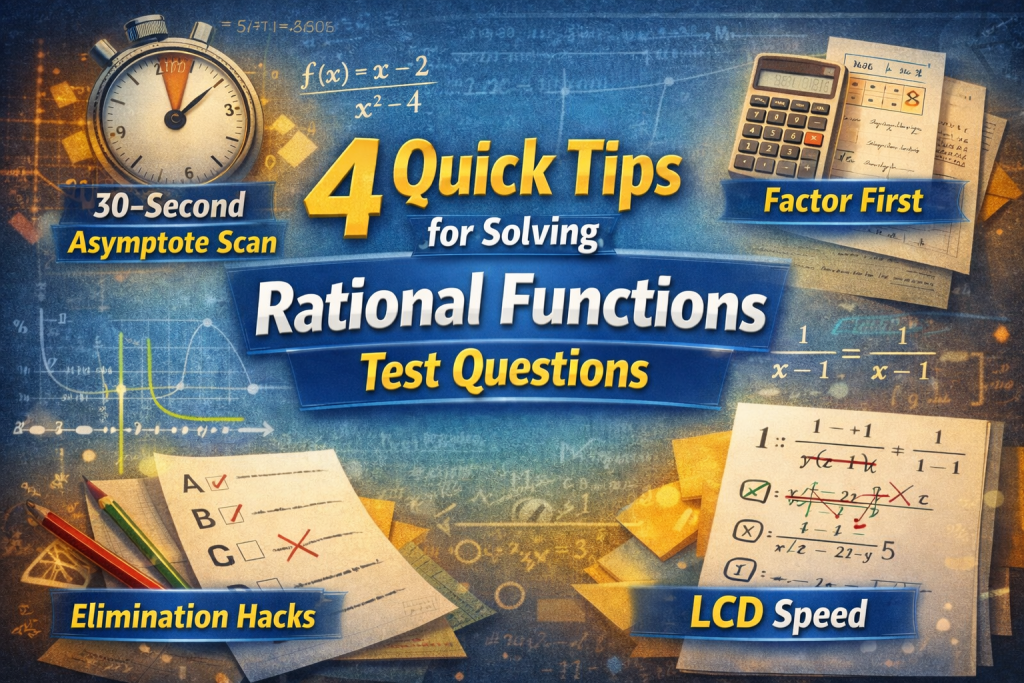
The 30-Second Asymptote Scan
You should always begin by scanning the function for its boundaries. These boundaries, or asymptotes, act like invisible fences that guide the shape of the graph.
Vertical Asymptotes (VA): You can find these by applying the “Denominator Zero” rule. Simply look at the bottom of your fraction and solve for ‘x,’ where the value equals zero. However, you must simplify common factors first to avoid falling into the “Hole” trap.
Horizontal Asymptotes (HA) Shortcuts: Instead of doing long division, you can use the Degree Comparison Test to identify the HA in seconds. This shortcut saves time during exams and supports deeper analytical work linked to mathematics dissertation topics involving function behaviour.
| Degree Comparison | Resulting Horizontal Asymptote |
| Bottom-Heavy (Denominator Degree > Numerator) | The asymptote is always y = 0. |
| Top-Heavy (Numerator Degree > Denominator) | No Horizontal Asymptote exists (look for a slant). |
| Balanced (Degrees are Equal) | y = ratio of the leading coefficients. |
Using these shortcuts helps you quickly find rational reasoning online homework answers without over-analysing the algebra.
Factor First, Solve Second
Before you calculate anything else, you must factor both the numerator and the denominator. This is your most important mandatory step because it reveals “hidden” features of the graph.
- Identifying Hidden “Holes”: These are also known as removable discontinuities. If a factor like (x – 2) appears in both the top and bottom of the fraction, it creates a hole rather than a vertical asymptote. You must spot these early to avoid test questions designed to trick you.
- Intercept Quick-Find: Once you have a simplified equation, you can find the coordinates of the points where the graph crosses the axes.
- x-intercepts: You set the simplified numerator to zero.
- y-intercept: You set x = 0 in the original equation and solve.
The “LCD” Speed Technique for Equations
When your homework quizzes present you with a complex rational equation, you don’t need to struggle with multiple fractions. You can use the Least Common Denominator (LCD) to clear the clutter.
Multiply every single term in the equation by the LCD. This action effectively “cancels out” all denominators, turning a messy rational expression into a straightforward polynomial. This is the fastest way to reach a critical, detailed answer during timed assessments.
However, you must always check for extraneous solutions. After you find your final answer, verify it against the original domain. If your solution makes the original denominator zero, you must discard it. Systems like Rational Reasoning IMathAS will penalise you if you include these invalid numbers.
Multiple-Choice “Elimination” Hacks
If you are taking a logical reasoning quiz with solutions and explanations, you can often find the right answer by proving others wrong. This is especially useful for test partnership tests that measure your speed and accuracy.
- End Behaviour Testing: If your test provides a graph, look at the “far ends.” If the graph approaches y = 2 as x becomes a very large number, you can immediately eliminate any options that don’t have an HA at y = 2.
- Test Point Strategy: For inequalities, you don’t need to solve the entire range. Pick one “easy” number, like x = 0 or x = 1, within an interval. Plug it in to see if it makes the statement true. This allows you to conclude an entire section of the graph instantly.
Practice Problems to Improve Rational Functions Test Scores
Practice indeed makes perfect. You must apply the learned theory to multiple scenarios to truly master your online homework system for mathematics.
| Focus Area | Example Function | Critical Thinking Goal | Expert Strategy |
| Spotting Holes | f(x)= x2- 9 x – 3 | Identify removable discontinuities before finding asymptotes. | Factor the top to (x-3)(x+3). Since (x-3) cancels, a hole exists at x=3. There is no vertical asymptote here. |
| Balanced Degrees | g(x)= 6×2+ 2 2×2- 5 | Find the Horizontal Asymptote (HA) when the degrees are equal. | Focus on the leading coefficients: 6/2. Your HA is y = 3. This dictates the graph’s end behaviour. |
| Bottom-Heavy | h(x)= x + 1 x2- 4 | Recognise the standard HA for functions with higher-degree denominators. | Because the denominator grows faster than the numerator, the HA is automatically y = 0. Solve x^2 – 4 = 0 for two vertical asymptotes. |
| Intercept Logic | h(x)= 2x – 8 x + 5 | Quickly locate where the graph crosses the $x$ and $y$ axes. | Set the numerator to zero (2x – 8 = 0) to find the x-intercept at (4, 0). Set x=0 to find the y-intercept at (0, -1.6). |
| Complex Solving | 3 x – 1+2 =5 x – 1 | Solve equations by clearing the fraction. | Multiply everything by the LCD (x-1). This gives 3 + 2(x-1) = 5. Solve for x, then verify it isn’t an extraneous solution. |
Why This Matters for Your Score
These patterns remove fear when you use Rational Reasoning IMathAS. . You start to see the “skeleton” of math. For instance, knowing the difference between a hole and a vertical asymptote is a common hurdle in rational reasoning assessment online homework.
If you encounter a multiple-choice question asking for the domain, look at the denominator first. You’ll know x cannot be 3 the moment you see x-3 at the bottom. This one realisation can help you eliminate half of the wrong options instantly. These examples train your brain for logical reasoning tests used by universities and employers.
.
Improving Math Reasoning Skills for Better Homework Scores
An Article from Taylor and Francis Online suggests that studying mathematics significantly improves a person’s numerical and logical reasoning skills, which are useful for day-to-day life. This implies that strengthening your overall math reasoning is like levelling up your brain’s operating system.
Once you understand the logic behind a complex problem, solving the Rational Reasoning assessment online homework becomes easier. Even if you forget a specific step along the way, you will still manage to construct the solution.
Try these mental strategies to boost your scores:
- Stepwise Problem-Solving: Write down every logical link to keep your thoughts organised instead of jumping directly to the final answer.
- Focus on Recognising Patterns: Look for recurring behaviours in functions, such as how the graph reacts as x approaches an asymptote.
- Explain the Logic Out Loud: If you can explain a concept to a friend, you truly master the material.
- Think in Ratios: Since rational reasoning involves fractions, visualise how increasing a denominator shrinks the overall value.
Conclusion – Boost Your Scores with Effective Rational Reasoning Tips
According to a WEF Future of Jobs Report, 65% of today’s schoolchildren will be working jobs in 2030 that don’t exist yet. The research implies that logical reasoning will be the core skill behind these careers.
By applying the strategies we’ve discussed in this guide, you can approach rational reasoning online homework answers with total confidence. If you still find it difficult to solve complex maths quizzes in your university tasks, let top-rated assignment writing services handle them for you. Their expert academic writers provide personalised guidance to help students understand each problem-solving step and learn from the ideal approach.
You are no longer just guessing, but using the same logic found in professional assessments like the Watson-Glaser test. Practice logic puzzles and rationality quizzes online frequently to sharpen these instincts. When you understand the “why” behind the asymptotes and holes, you stop searching for random answers and start calculating them with precision.
Frequently Asked Questions About Rational Reasoning Online Homework and Rational Functions Tests
Where can students find module‑based homework and official homework solutions for Rational Reasoning courses?
You can usually find your Rational Reasoning homework solutions by module through your university’s Learning Management System (like Canvas or Blackboard) or directly on the Rational Reasoning platform. Your instructor typically provides the specific course key needed to unlock these modules and access the official practice diagnostics.
Do official homework solution pages accompany each Rational Reasoning module?
Official homework modules and solutions are available on the Rational Reasoning IMathAS portal or integrated into your school’s LMS (like Canvas). Your course instructors typically manage access to “Homework Solutions” pages within each module. You can view answers through the portal’s “Gradebook” after deadlines pass or by using the “Jump to Answer” feature. Check your “Course Materials” folder within IMathAS to see if your teacher has released PDF guides for previous investigations.